The Ripple Effect
-News and Commentary-
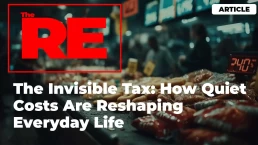
The Invisible Tax: How Quiet Costs Are Reshaping Everyday Life
By TP Newsroom Editorial | Ripple Effect Division
There are moments when the economy feels heavier than the numbers suggest. You look at your paycheck and it looks the same. You look at your bills and they look a little higher, but nothing dramatic. You adjust the budget, cut a subscription, buy a cheaper brand, try to convince yourself nothing is wrong. But the pressure doesn’t go away. It sits there. Quiet. Constant. Familiar enough that you stop questioning it.
That pressure is the invisible tax. The one nobody voted on. The one no politician holds a press conference about. The one that drains people slowly, a few dollars at a time, until the space between what they earn and what they owe feels tighter every year. It’s not a formal tax. It’s the cost of living shaped by systems most people never see and rules they never agreed to.
You feel it every time the grocery receipt surprises you even though you bought the same items as last week. You feel it when rent climbs for the third year in a row despite nothing changing in the building. You feel it when the electric bill adds another mysterious fee. You feel it when your car insurance jumps without explanation. None of these increases come with a policy debate or a vote. They just arrive.
People try to explain it away. Inflation. Supply chain issues. Strong demand. Global markets. But after a while, the explanations start sounding like distractions. The truth is simpler. A lot of the rising cost of living has nothing to do with economic fundamentals and everything to do with leverage. When industries consolidate, when fees multiply, when companies quietly coordinate their moves, the public ends up paying the difference.
And that’s what this invisible tax really is its the financial space companies take from people because they can. Not because the goods cost more to produce. Not because the service improved. But because the structure shifted in their favor and the public has no way to opt out. It’s a tax extracted through everyday transactions. It shows up on the receipt, not in the legislation.
You can see the effects in how people navigate their lives. They delay doctor visits. They switch jobs for an extra dollar an hour. They avoid childcare they can’t afford. They push necessary repairs into the future. They buy smaller portions, cheaper meats, fewer extras. They stretch themselves thin because stretching feels easier than stopping the bleed.
What makes the invisible tax dangerous is how quietly it spreads. Most people think they’re falling behind because they made a mistake, not because the system keeps taking from them without announcement. They blame themselves instead of questioning the structure. And once people internalize that, the invisible tax becomes even harder to name.
The country keeps telling a story about personal responsibility. Work harder. Budget better. Hustle more. But responsibility only explains one side of the equation. The other side is shaped by forces people never see and those forces keep raising the price of entry into a stable life.
This isn’t a story about a single industry or a single policy. It’s a story about pressure that became permanent. And once pressure becomes permanent, it becomes part of the landscape. People adjust without realizing they’re adjusting. They normalize what shouldn’t be normal. They accept what they shouldn’t accept. And that’s when the invisible tax becomes the rule instead of the exception.
If this work helped you understand something more clearly, support it by:
Buying the books | Visiting the Newsstand | Making a donation
One voice. One message. One Goal. Truth.
No spam. No schedules.
The Truth is Underfunded. That's Why This Exists.
No ads. No sponsors. No filter. Just the truth, unpacked, explained, and raw.
Defining Policy. Power. Consequence.
See how to add us to your home screen
The easiest way to see the invisible tax is to look at how prices move even when nothing else does. When supply stays steady. When demand stays steady. When production costs stay the same. Yet the bill still climbs. It climbs because companies have learned they can raise prices in small steps without backlash. People complain, but they still buy the essentials. They adjust their budgets. They accept the hit. And once acceptance becomes predictable, the price becomes flexible.
You can see it with groceries first. A product that cost three dollars last year quietly rises to three fifty. Then three seventy nine. The packaging shrinks. The quality dips. But the price holds or increases. This is not inflation in the traditional sense. It is engineered scarcity mixed with strategic pricing. Companies learned that they can charge more for less as long as they disguise the difference in small increments.
Utilities work the same way. The base service barely changes. The infrastructure does not improve. Yet a new fee appears. Then another. Eventually the monthly bill has five or six add ons that are not tied to usage. They are tied to leverage. People need electricity. They need water. They need internet. When a service is unavoidable, the room for price manipulation widens.
Insurance companies took the same playbook and refined it. Premiums rise every year even when no claims are filed. Deductibles climb. Coverage shrinks. And if someone tries to switch providers, they often find the competitors are raising rates at the same time. That is not coincidence. That is structural alignment inside an industry that rewards coordinated timing instead of open competition.
The financial sector adds another layer. Banks charge overdraft fees that go far beyond the cost of processing the transaction. They add maintenance fees. Transfer fees. ATM fees. These charges hit people who have the least room to navigate them. A person living fine on paper can still lose a chunk of their income every month to charges that have nothing to do with interest rates or lending risk. It is revenue pulled from people who can least afford it.
The invisible tax thrives because each increase is small enough not to spark outrage but large enough to accumulate. A family feels it across five or ten different bills. A worker feels it when groceries and gas move at the same time. A small business feels it when supplier costs jump without warning. No single increase tells the whole story. The story only becomes clear when you step back and see how many hands are taking a little more from the same paycheck.
What makes this worse is the illusion of choice. People think switching brands or companies will solve the problem. But the ownership structures are so consolidated that many alternatives trace back to the same handful of corporations. The public believes they are choosing between competitors when they are often choosing between subsidiaries. The invisible tax hides inside that illusion because the system presents variety while extracting money through uniform pricing strategies.
And while all this is happening, wages barely move. People are asked to absorb costs that climb faster than their income. They stretch. They hustle. They work overtime. They adjust everything except the one thing they cannot control — the rules of the economy itself. That gap between what people earn and what the system takes is where the invisible tax lives.
There is another layer to the invisible tax, and it shows up in the places people rarely examine. It is not the obvious costs. It is the quiet ones. The ones tucked into routines so familiar that no one questions them anymore. A gas station fee for using a card. A service charge for buying a ticket online. A delivery fee for the same restaurant that used to let you pick up your order without any extra cost. These are small amounts. But small amounts multiplied across millions of transactions turn into real money. And none of it reflects the actual cost of providing the service. It reflects the cost of realizing people stopped paying attention.

Subscription models took this concept even further. What used to be a one time purchase became a monthly bill. Software moved first. Entertainment followed. Then everyday household items. Companies realized predictable revenue was more valuable than selling a product once, so they built systems that made cancellation difficult and reactivation automatic. People end up paying for services they barely use because the system is designed to make opting out inconvenient.
This quiet drain spreads through local economies as well. When landlords see national rent trends rise, they match the increase even if local conditions do not justify it. When corporations raise prices across different regions, smaller businesses often follow because they assume the change is normal. The invisible tax becomes cultural. It becomes the default. Everyone raises prices because everyone else is raising prices, and the public absorbs the difference because they have no counter leverage.
Healthcare amplifies the pattern with a sharper edge. A routine appointment becomes a negotiation. A simple procedure results in a bill that looks nothing like the estimate. Insurance denies something unexpectedly. A pharmacy raises the cost of a medication without notice. None of these decisions are tied to a public conversation about costs or fairness. They are internal choices made by companies that know the average person does not have the time or energy to challenge every line item.
What makes the invisible tax so effective is how fragmented it is. No single increase is large enough to spark a public fight. No single company receives enough blame to become the face of the problem. The pressure spreads so evenly across so many parts of daily life that people cannot track the source. They only feel the outcome. The fatigue. The budgeting stress. The feeling that every year demands more from them just to maintain the same quality of life.
This fragmentation also protects the structure. Regulators focus on individual price hikes, not the pattern. Politicians debate headline issues, not the steady erosion underneath them. And the public learns to expect the squeeze as a fact of life. Even the language shifts. People say everything is expensive now as if the reality cannot be changed. The invisible tax becomes permanent because it becomes familiar.
The truth underneath all of this is simple. Companies raise prices when they believe they can do it without consequences. They test the limits. The public adjusts. And the adjustment signals the next increase. It is not a formal tax, but it functions like one. Money leaves households and flows upward into corporate profits without being labeled as a public contribution. It is extracted from people who have no representation in the decisions shaping the cost.
The invisible tax is not collected by the government. It is collected by power. And the public pays it every time they interact with a system that was designed to take more while offering the same or less.

There is another layer to the invisible tax, and it shows up in the places people rarely examine. It is not the obvious costs. It is the quiet ones. The ones tucked into routines so familiar that no one questions them anymore. A gas station fee for using a card. A service charge for buying a ticket online. A delivery fee for the same restaurant that used to let you pick up your order without any extra cost. These are small amounts. But small amounts multiplied across millions of transactions turn into real money. And none of it reflects the actual cost of providing the service. It reflects the cost of realizing people stopped paying attention.
Subscription models took this concept even further. What used to be a one time purchase became a monthly bill. Software moved first. Entertainment followed. Then everyday household items. Companies realized predictable revenue was more valuable than selling a product once, so they built systems that made cancellation difficult and reactivation automatic. People end up paying for services they barely use because the system is designed to make opting out inconvenient.
This quiet drain spreads through local economies as well. When landlords see national rent trends rise, they match the increase even if local conditions do not justify it. When corporations raise prices across different regions, smaller businesses often follow because they assume the change is normal. The invisible tax becomes cultural. It becomes the default. Everyone raises prices because everyone else is raising prices, and the public absorbs the difference because they have no counter leverage.
Healthcare amplifies the pattern with a sharper edge. A routine appointment becomes a negotiation. A simple procedure results in a bill that looks nothing like the estimate. Insurance denies something unexpectedly. A pharmacy raises the cost of a medication without notice. None of these decisions are tied to a public conversation about costs or fairness. They are internal choices made by companies that know the average person does not have the time or energy to challenge every line item.
What makes the invisible tax so effective is how fragmented it is. No single increase is large enough to spark a public fight. No single company receives enough blame to become the face of the problem. The pressure spreads so evenly across so many parts of daily life that people cannot track the source. They only feel the outcome. The fatigue. The budgeting stress. The feeling that every year demands more from them just to maintain the same quality of life.
This fragmentation also protects the structure. Regulators focus on individual price hikes, not the pattern. Politicians debate headline issues, not the steady erosion underneath them. And the public learns to expect the squeeze as a fact of life. Even the language shifts. People say everything is expensive now as if the reality cannot be changed. The invisible tax becomes permanent because it becomes familiar.
The truth underneath all of this is simple. Companies raise prices when they believe they can do it without consequences. They test the limits. The public adjusts. And the adjustment signals the next increase. It is not a formal tax, but it functions like one. Money leaves households and flows upward into corporate profits without being labeled as a public contribution. It is extracted from people who have no representation in the decisions shaping the cost.
The invisible tax is not collected by the government. It is collected by power. And the public pays it every time they interact with a system that was designed to take more while offering the same or less.

You can always tell when an invisible cost stops being subtle and starts shaping the way people live. It shows up in the conversations people have with themselves before they make a purchase. It shows up in the hesitation. The double checks. The tiny calculations they do in their heads. Not because the item is extravagant, but because the wiggle room they used to have is gone.
Families feel it first. A grocery run becomes a negotiation. Do we need this today. Can it wait until next week. Can we stretch what we already have. People start treating normal purchases like luxury decisions, even when they are just trying to keep the fridge full. They switch brands, switch stores, switch habits. But no matter how they adjust, the cost keeps finding them from a different angle.
You can see the impact in the way people use their cars. Fewer trips. More planning. Waiting an extra day before filling the tank. Gas used to be a routine expense. Now it is a line item people strategize around. Not because they are irresponsible. Because the margin between earning and surviving has thinned so much that even a small jump in fuel shifts the entire week.
Small businesses feel it in a different way. They watch supplier prices rise. They watch shipping fees climb. They watch processing costs increase even when their own revenue stays flat. Owners end up absorbing the difference because raising prices risks losing customers who are struggling with the same squeeze. The invisible tax punishes the bottom and the middle at the same time, just through different entry points.
Workers feel it in the quiet choices they make. Postponing medical care. Delaying dental visits. Holding off on replacing a worn tire. Stretching prescription medication longer than they should. The cost of waiting becomes the cost of surviving. And the system counts on people doing exactly that because it lowers public pressure and keeps the structure intact.
The emotional impact settles in quietly. People blame themselves. They think they miscalculated. They think they lost control. They think everyone else has it figured out. The invisible tax works because it convinces people their struggle is individual instead of collective. And once that mindset sets in, people lose the energy to question the system causing it.
Communities feel it as well. Local events shrink because organizers cannot afford rising vendor fees. School fundraisers stretch further because families cannot contribute like they used to. Churches and non profits feel donations drop. The invisible tax drains the same dollars communities rely on to support themselves. It weakens the connective tissue that keeps neighborhoods stable.
And then there is the psychological exhaustion. The steady drip. The feeling that every year takes more out of people while giving them less in return. They start expecting disappointment. They start assuming strain. They stop hoping for a break because the break never comes. This is the part that does not get measured on charts or reported in quarterly forecasts, but it shapes the country more than any statistic.
The invisible tax does not look like a crisis because it does not create a single moment of panic. It creates a long timeline of pressure. A pressure that reshapes how people choose, how they plan, how they dream, and how they understand their own future. That is the impact. Not the extra dollars. The erosion of space, stability, and confidence that used to exist between paydays.
The strange thing about the invisible tax is how neatly it hides inside ordinary life. It doesn’t look like a policy. It doesn’t look like a law. It doesn’t even look intentional at first. It just shows up in the gaps between what something should cost and what it actually costs. And because the gaps are small, people treat them like noise instead of signals.
But when you look at those gaps together, the shape becomes clear. This is not random. It is the economic result of systems that reward extraction over competition. When companies realize they can raise prices without losing customers, they keep doing it. When they learn they can add fees without consequence, the fees multiply. When they see people adapting instead of resisting, the adaptation becomes part of the business model.
The incentives run in one direction. Charge more. Offer less. Make the increase small enough that no one fights it. Spread the cost across enough industries that people cannot trace the source. That is how the invisible tax becomes self sustaining. The system does not have to explain itself. It just has to be predictable enough that people stop imagining alternatives.
You can see the structure behind it when you follow where the money goes. Profits hit record highs. Share buybacks accelerate. Executive compensation packages climb. Meanwhile wages barely move. Benefits shrink. Job security weakens. The economy celebrates productivity while the workers generating the productivity see none of the reward. This gap is not accidental. It is engineered through decisions made far from the people who end up paying for them.
The invisible tax also grows because regulators treat each price increase as an isolated event. They examine one sector at a time. One company at a time. One violation at a time. But the invisible tax is not a violation. It is the cumulative effect of structural power. It spreads across industries like a shared language. Once one company learns the script, others follow. And because the moves are legal, the system adjusts around them instead of pushing back.
People underestimate how much culture plays into this. An economy teaches people what they should expect. Over time the expectation becomes reality. If every bill rises at the same pace, people assume that is normal. If every company adds fees, people assume fees are unavoidable. If every grocery store shrinks its packaging, people assume the quantity change is a natural part of inflation. The culture absorbs the pressure and passes it forward.
This creates a feedback loop. Companies raise prices. The public adjusts. The adjustment signals stability. Stability signals room for another raise. The cycle repeats. And because the burden lands quietly, people think their struggle is private instead of systemic. That is the trick of the invisible tax. It convinces individuals to carry a weight created by the structure itself.
The first half of the analysis is about identifying the pattern.
The second half is about what that pattern means for the future if it continues.
There is a point where an invisible cost stops being quiet pressure and starts becoming a structural truth. It creeps up slowly. People try to adjust their habits, cut back, find shortcuts, do more with less. But at some point the adjustments stop working because the problem is not personal. It is systemic. And systems do not fix themselves just because the people inside them are trying to survive.
The deeper issue is what the invisible tax is training the country to accept. It is teaching people that stability is fragile. It is teaching them that bills can rise without reason. It is teaching them that companies can extract more without offering anything in return. And once a society learns that lesson, it stops expecting fairness. It stops expecting transparency. It stops expecting any connection between cost and value.
That shift reshapes the national psychology. People start navigating every financial decision with suspicion, with hesitation, with a quiet fear that the next increase is already on the way. They imagine worst case scenarios because the best case scenario rarely shows up anymore. Even when they do everything right, the pressure returns. That feeling settles into the way people talk, the way they plan, the way they imagine their own futures.
The invisible tax also changes how households think about risk. When the margin between earnings and expenses gets too thin, people stop taking chances. They do not start businesses. They do not change careers. They do not move to new cities. They do not invest in themselves. The economy calls it caution. But it is not caution. It is survival. You cannot take risks when the ground beneath you keeps shifting.
And the system benefits from that fear. When people are too stretched to challenge anything, the structure stays intact. When people are too tired to demand better, the system becomes harder to reform. Every year the pressure builds, and every year the public grows more accustomed to living with less space, less certainty, and less room to breathe.
There is also a generational cost. Children grow up watching their parents juggle rising bills. They grow up hearing conversations about cutting back. They grow up watching vacations disappear, repairs delayed, opportunities skipped. They absorb that lesson before they ever have a paycheck. They learn that adulthood is not about building. It is about adjusting. It is about absorbing impact after impact with no expectation that the system should treat them any better.
Over time that becomes culture. Not financial culture. Emotional culture. A sense that the world is structured to take from them in ways they cannot explain and cannot fight. And once that mindset sinks in, the invisible tax becomes more than an economic issue. It becomes a psychological one.
The reason this matters is simple. A society cannot function when the majority of its people feel squeezed by forces they cannot see, cannot influence, and cannot escape. A system built on quiet extraction does not collapse dramatically. It erodes quietly. It wears people down. It drains their confidence. It makes them settle for less not because they want less, but because the alternative feels impossible.
This is the part policymakers always miss. They focus on charts and indicators. They focus on percentages and projections. But the invisible tax does not show up on a chart. It shows up in the way people breathe. The way they sleep. The way they think about the next five years. And once the pressure becomes normal, the country starts losing something deeper than money. It loses the belief that the system is supposed to work for them at all.
That is the heart of the analysis.
The system did not fail.
It shifted.
And the people inside it are living with the consequences every single day.

There is nothing dramatic about the invisible tax. No alarms. No headlines. No single event that marks the beginning or the end. It works because it stays quiet. It grows in the space between what something costs and what people can afford. It settles into the cracks of daily life until the cracks feel like part of the foundation.
People carry that weight in different ways. Some tighten their budget and hope the pressure eases later. Some pick up extra hours. Some cut back on things they used to enjoy. Some pretend the squeeze is temporary even though the pattern keeps repeating. And eventually the pressure becomes familiar. Not comfortable. Just familiar enough that people stop asking why the system needs so much from them to begin with.
The truth is that the invisible tax doesn’t steal hope all at once. It does it slowly. It chips away at the small forms of comfort that used to make life feel manageable. It eats into the moments where people used to breathe. It turns simple decisions into math problems. And the exhaustion that follows doesn’t feel like an economic issue. It feels personal. Like a reflection of someone’s choices rather than a reflection of the structure above them.
But none of this is personal. It never was. It is the predictable outcome of an economy built on quiet extraction. The companies that set the prices do not see the families rearranging their lives beneath them. The people absorbing the pressure do not see the decisions being made in boardrooms far away from their kitchens, their gas tanks, their grocery carts. That distance is what protects the system. It keeps the cause invisible and the burden visible.
A country cannot thrive on that arrangement forever. People can only carry pressure they cannot explain for so long before something inside them goes numb. Once that numbness spreads, belief in the future shrinks. And when belief shrinks, the country stops feeling like a place where progress is possible. It becomes a place where people brace themselves instead of build.
The quiet conclusion is simple. The invisible tax is not just about money. It is about space. The space people used to have between bills. The space they used to have to recover from setbacks. The space they used to have to dream without fear. That space is disappearing. And when enough people lose that space, the country loses something with it.
This is not a story about collapse. It is a story about erosion. Slow. Steady. Unnoticed until the damage becomes impossible to ignore. And while the pressure may feel ordinary by now, it is not normal. It is a signal. The kind that tells you the system has drifted too far from the people it was supposed to serve.
One story. One truth. One ripple at a time.
Konczal, M., & Lusiani, N. (2022). Prices, profits, and power: An analysis of 2021 firm-level markups. Roosevelt Institute. https://rooseveltinstitute.org/publications/prices-profits-and-power/
Bureau of Labor Statistics. (2023). Shrinkflation: When product sizes shrink but prices don’t. https://www.bls.gov/opub/btn/volume-12/shrinkflation.htm
Federal Trade Commission. (2023). FTC launches inquiry into prescription drug middlemen and drug manufacturers. https://www.ftc.gov/news-events/news/press-releases/2023/07/ftc-continues-inquiry-pbm-practices
OECD. (2023). Profits, prices, and wages: The role of market power in inflation. https://www.oecd.org/economy/profits-prices-and-wages-market-power-inflation.htm
Furman, J., & Orszag, P. (2015). A firm-level perspective on the role of rents in the U.S. economy. Brookings Institution. https://www.brookings.edu/articles/a-firm-level-perspective-on-the-role-of-rents-in-the-u-s-economy/
Consumer Financial Protection Bureau. (2023). CFPB targets junk fees in banking, credit, and payments. https://www.consumerfinance.gov/about-us/newsroom/cfpb-takes-action-to-curtail-junk-fees/
Economic Policy Institute. (2022). The new gilded age: Income inequality in the U.S. by state, metropolitan area, and county. https://www.epi.org/publication/the-new-gilded-age-income-inequality-in-the-u-s-by-state-metropolitan-area-and-county/
If this work helped you understand something more clearly, support it by:
Buying the books | Visiting the Newsstand | Making a donation
One voice. One message. One Goal. Truth.
No spam. No schedules.
The Truth is Underfunded. That's Why This Exists.
No ads. No sponsors. No filter. Just the truth, unpacked, explained, and raw.
Defining Policy. Power. Consequence.
See how to add us to your home screen